
Every financial transaction in Africa today relies on encryption that could be obsolete tomorrow. From mobile wallets in Lagos to cross-border payments in Nairobi, digital finance depends on algorithms designed decades ago. But with quantum-safe cryptography computing moving from theory to practice, that foundation is under threat.
The risk isn’t abstract. If quantum machines mature as experts predict, the very ciphers protecting payment networks, banking APIs, and customer data could be broken, leaving fintech platforms exposed to massive breaches and loss of trust. For an industry built on speed, trust, and compliance, this is a ticking clock.
This article explains what quantum-safe cryptography really is, why fintech leaders across Africa should care now, and what practical steps they can take to prepare before quantum power reshapes digital security.
Why Quantum-Safe Matters Now
At the heart of modern digital security are encryption standards like RSA and elliptic curve cryptography (ECC). These have protected banking systems, digital wallets, and internet communications for decades. They work because breaking them with classical computers would require impractically large amounts of time and computing power.
Quantum computers, however, change that equation. Algorithms like Shor’s algorithm can factor large numbers exponentially faster than classical systems, making today’s encryption effectively breakable once quantum machines scale.

This isn’t just a concern for tomorrow. The “harvest now, decrypt later” strategy means attackers could already be intercepting and storing encrypted African financial data today, waiting for the day quantum power makes it readable.
For African fintechs, where mobile money adoption is among the highest in the world and millions of users depend on digital transactions, the stakes are enormous.
Risks to African Fintech
The fintech boom across Africa has brought inclusion and innovation, but it also raises systemic vulnerabilities in a quantum world.
- API Security: Payment gateways and open banking APIs rely heavily on encryption for authentication and integrity. A quantum break could expose millions of transactions.
- KYC and Identity Data: From biometric records to digital IDs, personal data could be stolen and decrypted, leading to identity theft and fraud.
- Digital Wallets & Mobile Money: Services like M-Pesa, Flutterwave, and OPay thrive on consumer trust. A breach in wallet security would be catastrophic for the adoption of blockchain technology.
- Regulatory Exposure: Central banks and regulators, such as the Central Bank of Nigeria or South Africa’s Financial Sector Conduct Authority, may soon require fintechs to adopt quantum-resistant measures as part of compliance frameworks.
- Global Investor Confidence: Venture capitalists and global partners are already asking about post-quantum readiness. A fintech unprepared for PQC risks is being left out of partnerships and funding rounds.
The Standards and Solutions Emerging
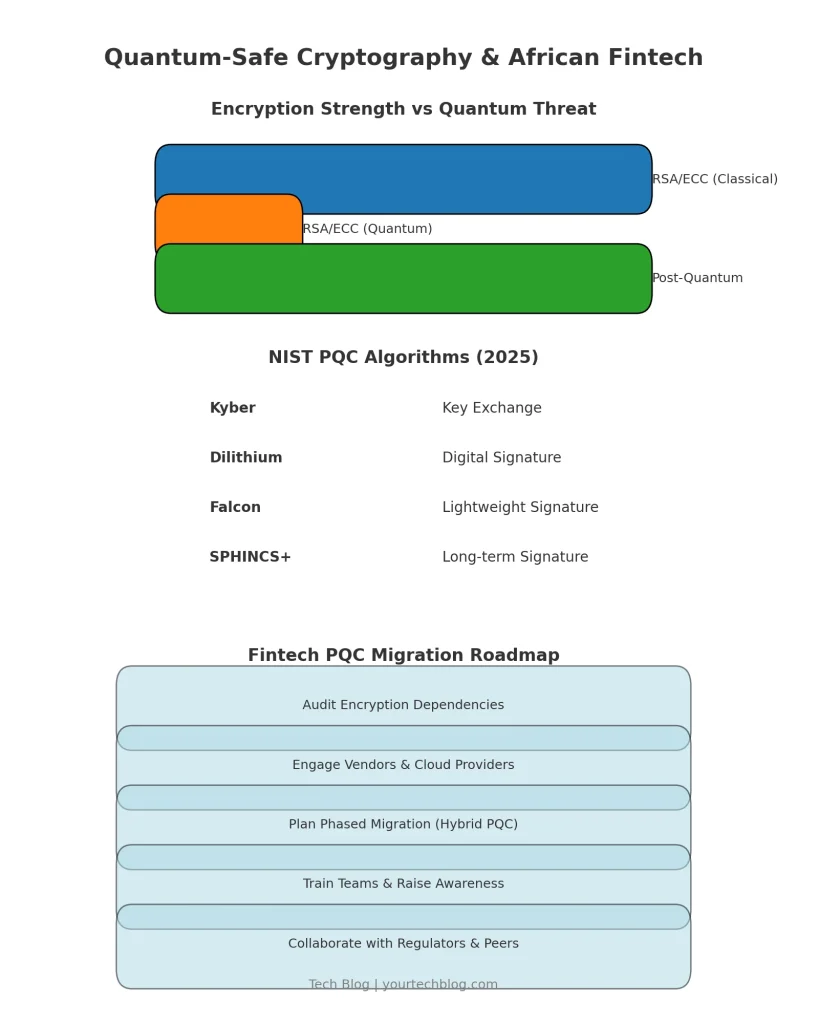
Fortunately, work on post-quantum cryptography (PQC) is well underway. In 2022, the U.S. National Institute of Standards and Technology (NIST) announced algorithms designed to withstand quantum attacks. Key picks include:

- Kyber (for key exchange)
- Dilithium, Falcon, and SPHINCS+ (for digital signatures)
These are being refined into global standards, and adoption is already starting in cloud platforms and enterprise software.
For African fintechs, the path will likely involve hybrid approaches that use both classical and PQC algorithms in parallel until PQC proves to be fully mature. Major providers like Google Cloud, AWS, and Microsoft Azure are already testing PQC within TLS connections, meaning fintechs can begin integration through their existing infrastructure.
What African Fintechs Should Do
Transitioning to quantum-safe systems won’t happen overnight. But fintech leaders can begin laying the groundwork now:
- Audit Encryption Dependencies
- Map where encryption is used: TLS, VPNs, APIs, payment processors, and databases.
- Identify high-risk areas where quantum exposure would be most damaging.
- Engage Vendors and Cloud Providers
- Ask infrastructure and payment providers about their PQC roadmaps.
- Ensure contracts and SLAs include commitments to quantum-safe upgrades.
- Plan a Phased Migration
- Start with critical APIs and sensitive data (e.g., customer KYC, payment authentication).
- Test hybrid implementations before moving entirely to PQC.
- Invest in Training and Awareness
- Equip cybersecurity and developer teams with knowledge of PQC libraries.
- Conduct workshops on NIST PQC algorithms and their integration.
- Collaborate with Regulators and Peers
- Share knowledge through African fintech associations.
- Stay ahead of regulatory mandates by adopting early.
The Road Ahead
Quantum-safe cryptography will not be free. Algorithms are often heavier, requiring more processing power and potentially raising transaction costs. But the alternative, being unprepared for a quantum breach, would be far more expensive in financial and reputational terms.
For Africa’s fintech ecosystem, there is also an opportunity. With many platforms still relatively young, fintechs can leapfrog older global institutions weighed down by legacy systems. By integrating PQC early, they can position themselves as leaders in secure digital finance, earning trust from regulators, investors, and millions of users.
In the near future, PQC compliance could become a competitive advantage, a trust badge displayed alongside licenses and audit certificates. The fintechs that adapt first will be the ones shaping Africa’s role in the global financial system.
Conclusion
Quantum-safe cryptography is no longer science fiction; it is a strategic priority. For African fintechs, the challenge is urgent but also full of possibilities. By auditing systems, engaging with providers, and planning migrations today, fintech leaders can protect their users, meet regulatory expectations, and build stronger brands for tomorrow.
The question is no longer if quantum computing will arrive, but when. Is your fintech ready for that future, or will it be caught unprepared?